Page 1 of 1
How a differential gear works
Posted: Fri Aug 13, 2010 2:46 pm
by Executioner
This is old video - 70 yrs, but it does a good job of explaining the basic principals of a differential.
<object width="480" height="385"><param name="movie" value="
http://www.youtube.com/v/K4JhruinbWc?fs ... ram><param name="allowFullScreen" value="true"></param><param name="allowscriptaccess" value="always"></param><embed src="
http://www.youtube.com/v/K4JhruinbWc?fs=1&hl=en_US" type="application/x-shockwave-flash" allowscriptaccess="always" allowfullscreen="true" width="480" height="385"></embed></object>
Posted: Fri Aug 13, 2010 3:19 pm
by normalicy
That's cool, I already knew the concept, but I liked how they went through the engineering thought process in improving it over time. I'm sure they didn't use sticks to start with though.
Posted: Fri Aug 13, 2010 10:02 pm
by FlyingPenguin
Very cool. Thx for that.
Posted: Fri Aug 13, 2010 11:58 pm
by Pugsley
I was hoping to also see limited slip and posi.
Posted: Sun Aug 15, 2010 11:30 am
by EvilHorace
I'm sure they didn't use sticks to start with though
Never gave it any thought before but apparently you didn't make sharp 360 degree turns with a horse drawn wagon back in the day but then too, the roads were dirt so it wouldn't be a problem.
Posted: Sun Aug 15, 2010 3:56 pm
by normalicy
Huh, I just figured that the axles weren't solid on wagons (i.e. each wheel spun independantly).
Posted: Sun Aug 15, 2010 5:23 pm
by Koo Koo Mouse
Norm your right, no reason to have them cross connected if its pulled. The horse brain managment sytem takes care of all that.. Indepentant hoovement.
Posted: Sun Aug 15, 2010 7:40 pm
by EvilHorace
http://en.wikipedia.org/wiki/File :E li ... canada.jpg
Don't know about all horse drawn wagons but the one pictured above has a front "axle" and probably a rear one too. "axle shafts" would have been needed to support each wheel as they'd be easy to hook up to the carriage, otherwise they'd need what we use today with front wheel drive cars that use rear trailing arms and then you'ld need to know something about rear caster, camber, toe, not required with a simple axle shaft.
More:
http://www.buggy.com/
http://www.google.com/images?q=horse+dr ... 80&bih=873
Posted: Sun Aug 15, 2010 8:59 pm
by FlyingPenguin
We have a carriage museum here and yeah, the rear is usually an axle. On fancy carriages the front usually has a steerable front axle.
At the speeds a carriage is going, it's probably not an issue.
Posted: Mon Aug 16, 2010 1:31 am
by normalicy
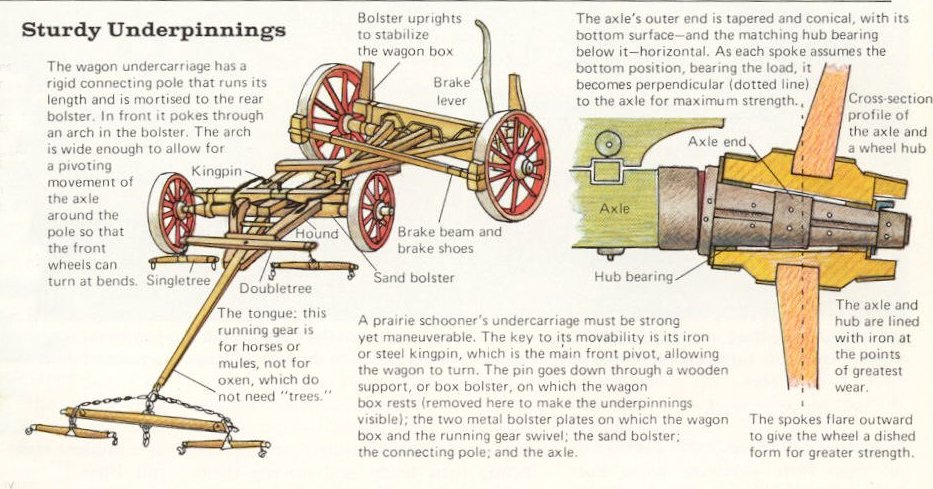
Yes, they have shafts, but I'm under the impression that the shafts weren't rigidly mounted to the wheel. I believe there was grease between the shaft & wheel. Otherwise, I could see the torque buildup from a 5-6 foot wheel being able to snap such frail axles (heck, I've seen torque snap modern 1 1/4" thick hardened steel axles with smaller tires).
Here's about the only info I could find on axle build. Though, they aren't specific about what's being zoomed in on.
Posted: Mon Aug 16, 2010 9:19 am
by FlyingPenguin
Yeah, that makes sense. It'd be easier to make the wheels spin on the shaft rather than spin the axle.
